Texas Revolution and Mexican American War
The states of Texas, California and New Mexico originally belonged to the vast Spanish Colonial Empire called New Spain – which stretched from South America, north to Oregon and east to the Mississippi River. The capital of New Spain was Mexico City. Spain mostly ignored these three states, concentrating on mining silver and gold in other parts of the Empire.
In August, 1821, Mexico defeated Spain to become an independent nation. Sadly, nobody in Mexican leadership had the knowledge of America’s Founding Fathers on how to establish and govern a free society.
Mexico inherited a huge amount of land north of the Rio Grande River, in Texas, California and New Mexico. but had very little control over it. Only one percent of the population of Mexico lived north of the Rio Grande River. In 1820,the population of Texas, a huge state, was only 2,000.(5) In 1821, Mexico invited Americans into Texas and by 1834 there were about 30,000 Anglos.[12a]
In 1823, only 2 years after independence – five states in Central America declared themselves independent from Mexico – Guatemala, El Salvador, Honduras, Nicaragua and Costa Rica.
In 1835, Santa Anna established a dictatorship and three states in Mexico revolted – Texas, Coahuila and Zacatecas. Only the Texas revolt was successful. Mexico vowed it would conquer Texas again, which resulted in the Mexican American War of 1846-48.
Summary of false allegations against the U.S.

Historical revisionists claim the U.S. provoked Mexico into attacking the U.S. Army in 1846 so the U.S. had an excuse to go to war and steal what became the southwest US from Mexico. The truth is Mexico was confident of victory. After being crushed, Mexico changed their story and made themselves out to be the victim. Most historical revisionists have blindly followed this bogus line. We need to follow the facts:
1. The southwest US is NOT historically Mexican/Spanish land. This land, like all land in the New World, was historically Indian land. The Spanish stole it from the Indians and then lost this land to the U.S.
2. Negotiations with Mexico over Texas were useless because Mexico refused to accept the loss of Texas. Mexican pride could not accept the fact that a bunch of outnumbered farmers, ranchers, businessmen and adventurous young men from the U.S. had defeated the Army of Mexico.But this colossal stain on Mexican pride could be fixed if Mexico reconquered Texas. Mexico considered Texas a breakaway province and wanted it back.
3. Mexico HAD to attack the U.S. Mexican politicians put themselves into a corner with 10 years of diatribes against America and incessant calls for war which kept the people in a war frenzy. After 10 years demanding war, it was time to confront Mexico: Accept the fact you lost to Texas and negotiate or start the war you keep saying you want. Because Mexico started the war does not prove the U.S. provoked Mexico. It proves Mexico chose war over negotiations.
4. Mexican President Herrera – who wanted to negotiate a peace deal – was overthrown by General Mariano Paredes in January, 1846. Paredes sole objective was to start a war with the U.S. Anyone in Mexico who wanted a peaceful resolution was branded a traitor.
5. In a letter dated Apr 18, 1846, Paredes wrote to General Arista who commanded the Mexican force along the Rio Grande River: “It is indispensable that hostilities begin, yourself taking the initiative.”(8) On April 25, 1846, 1,600 Mexican troops crossed the Rio Grande and ambushed a force of 80 American troops. Eleven Americans were killed and the rest taken prisoner. Mexico got the war they wanted.
6. Critics of the U.S. for over 150 years have condemned the U.S. for sending troops to the Rio Grande, maintaining this was a ploy intended to provoke Mexico into starting the war. This is bogus reasoning and ignores facts. Who was provoking who?? How could the U.S. be responsible for provoking a war with a country that had repeatedly declared war on the U.S., refused to negotiate, vowed to conquer Texas and was putting an invasion force on the border?

7. Mexico did NOT attack Texas over a boundary dispute. Mexico NEVER said they merely wanted to conquer the land up to the Nueces River.(95) The Neuces River is about 125 miles north of the Rio Grande River. If Mexico wanted the boundary to be the Nueces, they had 10 years to bring it up with Texas, and later the U.S. and negotiate a deal. The obvious truth was that Mexico was NEVER going to negotiate over the Texas border since that would be an admission that Texas was separate from Mexico. Mexico intended to conquer all of Texas.
8. Taylor’s army left Corpus Christi for the Rio Grande River on March 8, 1846. General Taylor wrote a proclamation to the people of Matamoros in which he alerted them to his march and promised that his intentions were peaceful.
Taylor arrived on the Rio Grande on March 28, 1846. Immediately, Mexico initiated a provacation, stealing 3 horses and taking two soldiers captive.(78-4) General Taylor immediately contacted Mexican General Mejia and demanded horses and men be returned. Taylor also wrote letters to both civilian and military authorities at Matamoros, expressing his desire to “enter into any arrangements to secure the peace and harmony of the frontier” until the US and Mexican governments could reach an official accord. Taylor also informed locals that the U.S. Army would pay for any damages done to their property.(78-4)
Despite these proclamations, Mexico made herself believe that General Taylor was going to invade Mexico. This was just more self induced hysteria by Mexico and a way to maintain war fervor.
9. Polk did NOT want a war with Mexico. The U.S. Army was untested against a conventional army. Many foreign observers believed the U.S. would have a tough time defeating Mexico – and many thought the US would lose.
Some observers believed it would take 250,000 US troops to defeat Mexico – a nation of over 7 million people with many rugged mountains. The ability of Mexico to wage guerrilla war against U.S. supply lines would prevent the U.S. from massing sufficient troops to defeat the Mexicans deep in their territory. Mexico could outlast the U.S. Eventually the Americans would tire of the war, the casualties, huge military spending and make peace on Mexico’s terms.(71)
If Polk was planning to go to war with Mexico, he would have begun a massive build up for the military, but he did not.(90)
10. The U.S. Army treated local Mexicans better than their own government. Locals refused to sell supplies to their own army because they were “paid” in promisory notes – which were worthless. Mexican officials were enraged when Mexicans eagerly sold food, cloth and horses to the American Army which paid in cash.(82)
11. The fact that a small American Army of less than 15,000 was able to control a country of 7 million people proves a lot of Mexicans were not that interested in fighting the “hated” Americans and stayed home. If all of Mexico had mobilized to defend the country, an army of over a quarter million men could have easily been raised.
12. Today, 180 years later, many Mexicans believe the Treaty of Guadalupe Hidalgo was too harsh on Mexico. So the issue today is: Even if Mexico was 100% to blame for starting both wars – which they were – did the US have the right to take almost half of Mexico’s territory? The answer is ABSOLUTELY YES!! Here’s why:
The war cost the U.S. at least $75 million. The only way Mexico could reimburse the United States for the cost of the war was a cession of land to the United States.(12) THIS 12 IS FROM CONDENSED
Mexico wanted this war. To have beaten Mexico as badly as we did, without Mexico suffering any consequences would not have been fair to us. This would have been an unforgivable disgrace to the men who died and the rest who went through hell to attain victory – and we would be inviting another attack.
Now put yourself in Mexico’s shoes. Your army has been repeatedly defeated, nearly the entire country has been conquered, and the consequences are – nothing!! Just be nice and don’t threaten Texas again! In a machismo society like Mexico, would they sit back and say ‘OK’ or would Mexicans think we Americans are unbelievably gullible. Mexico would hold Americans in contempt for conquering their country and not making them pay a price for their warmongering.
13. Most Mexicans believe that if they had kept ownership of the land north of the Rio Grande – Texas, California and New Mexico, these areas would be economically prosperous like they are now. This is delusional thinking. These areas became prosperous because they belong to the US, not Mexico. Had these lands stayed under the control of Mexico, they would not have helped Mexico prosper. All that would change is that constant revolutions, widespread poverty, a disastrous economic system, bad health care, political turmoil and murderous drug cartels would be in a country twice as large as it is now. Even more illegal immigrants would be coming into our considerably smaller country looking for jobs.
14. This war was not a fulfillment of an abstract concept known as Manifest Destiny. The rebellion of 1836 was a result of Santa Anna establishing a dictatorship. The minutes of public meetings, town councils, and committees of correspondence, as well as private letters, provide extensive proof that in early 1835 most people were content being citizens of Mexico.(27) Immigrants went to Texas and California for free land. Immigrants to Texas got one league (about 4500 acres) for free and immigrants to California got 11 leagues (about 50,000 acres) for free. If a settler bought unoccupied land in the US, you paid the federal government $1.25 per acre.(91-9)
It’s important to recognize that Spain/Mexico, like many other countries, had their own version of “Manifest Destiny.” Spain’s “manifest destiny” was to conquer all of the New World (except for Brazil) for Spain and Catholicism. Incredibly, Spain wanted more then just the New World. In 1513, Vasco Balboa claimed the entire Pacific Ocean and all lands adjoining it for Spain. Although Balboa didn’t know it, he claimed modern day United States, Canada, Alaska, Siberia, Japan, Korea, China, The Philippines, Vietnam, Indonesia, Malaysia and Australia – all for Spain.
These land claims by Spain were meaningless. While Spain/Mexico was claiming land just to claim it – land they had a difficult time putting people on – the U.S. was expanding based on a growing population.
15. Following the war, a segment of American society came to the belief that the war with Mexico was an unjust war – a stronger nation beating up a weaker nation. The only reason this viewpoint was credible was because the U.S. won so decisively. Prior to the war, Mexico was certain they would win. The truth is that in most every battle, the difference between victory and defeat for the U.S. was VERY small. The U.S. Army was always outnumbered by large margins. With a mistake here and there, America could easily have lost the war.
Had Mexico not started a war with the US, Mexico wouldn’t have lost the southwest US, or if they did, there could be no denying that the US stole it.
=========================================================
Insurrections in Texas and Mexico
In 1811, Juan Bautista de las Casas lead a revolt against Spanish authorities. The revolt was put down by Spanish royalists.(1) In 1812, another attempt to conquer Texas was led by Bernardo Gutierrez and American Augustus Magee. Initially succesful, the revolt was crushed by royalist Joaquin Arredondo with hundreds of Texans killed in combat and hundreds more killed after surrendering.(2)

After Mexico became independent, most Mexicans believed they would become a prosperous nation as the US was becoming. This didn’t happen because of political instability and corruption. Nobody in Mexican leadership had the knowledge of America’s Founding Fathers on how to establish and govern a free society.

A mere three years after independence, the Congress, in a solemn address to the nation, stated that without virtue, liberal institutions would fail, revolution would follow revolution and anarchy would ensue.(3) As the years went by, politicians increasingly blamed all their problems on America.
Mexico’s first leader after independence nation was Agustín de Iturbide. He was crowned emperor by Congress on 19 May 1822. He abdicated on 19 March 1823 and later fled to Europe. He returned to Mexico in July 1824 and was arrested and executed.
The political instability continued. Vice President Nicolas Bravo lead a revolt in Dec. 1827. It was put down in Jan. 1828. Bravo was expelled from the country while other mutineers were imprisoned.
Another revolt occurred over the results of the Presidential elections of Sep 1, 1828. The winner was Manuel Gomez Pedraza, who was supported by President Victoria. Vicente Guerrero rejected the results and organized a revolution with Santa Anna and others. After rebel forces bombarded the National Palace, Congress annulled the election of 1828 and made Vicente Guerrero President.
Five states secede from Mexico

Due to the dysfunctional state of Mexican politics – and only 2 years after independence – five states in Central America declared themselves independent from Mexico – Guatemala, El Salvador, Honduras, Nicaragua and Costa Rica. On July 1, 1823, the United Provinces of Central America was formally established.
Constant infighting resulted in the Union falling apart in 1838. The five states became independent nations without any interference from Mexico or threats of perpetual war.
Conditions that resulted in the Texas Revolt
Mexico was becoming ungovernable. So Santa Anna was appointed President in May, 1833 to restore order. Santa Anna became increasingly dictatorial and in 1835, he abolished all state legislatures and centralized all power in Mexico City.
This centralization of power by Santa Anna caused the Mexican states of Texas, Coahuila and Zacatecas to revolt. On May 11, 1835 Santa Anna’s Army crushed the revolt in Zacatecas with 2,000 civilians being killed. Fearing a similar fate, the governor of Coahuila, Agustin Viesca, disbanded the legislature on May 21.
On June 25, Viesca issued the following appeal: “Citizens of Texas, arise and take arms, or sleep forever! Your most cherished interests, your liberty, your properties, even more, your very existence depend on the changing whims of your most relentless foes.”(1)
The Texas Revolution

Hostilities started in Texas in Oct. 2, 1835. On March 6, 1836 Santa Anna’s Army overwhelmed Texans – and a small number of Mexicans – defending the Alamo, with around 200 men fighting to the death.
On 20 March, 1836, 400 Texans surrendered near Goliad – and a week later were massacred on orders from Santa Anna, who then ordered their bodies to be piled up and burned.
Texas was on the brink of defeat, but on April 21, 1836, San Houston’s Army of 750 men defeated Santa Anna at San Jacinto River. Over 700 Mexicans were killed and 730 captured – including Santa Anna. Incompetence by Santa Anna was the reason Texas defeated the Mexican Army at San Jacinto.
After his capture, Santa Anna replied to a letter from former American envoy to Mexico Joel Poinsett: [19] “A hundred years to come my people will not be fit for liberty. They do not know what it is, unenlightened as they are. . .” “. . .a despotism is the proper government for them.”
On May 14, 1836, while still a prisoner of Texas, Santa Anna signed the Treaties of Velasco that ended the war and made Texas an independent country. The Rio Grande River became the boundary between Mexico and Texas.
General Filisola, Santa Anna’s second in command took over, and despite considerable opposition from other officers, began withdrawing Mexican troops from Texas in accordance with the peace agreement signed by Santa Anna. But on May 20, the Mexican government declared the treaties Santa Anna had signed in captivity to be null and void and ignored the treaty. On May 28, the Mexican government ordered Filisola to maintain control over parts of Texas already conquered. However, his troops were in no condition to go on another offensive, and Filisola completed the withdrawal to Mexico, on the south side of the Rio Grande River.
Concerning Mexico’s atrocities against Texans, Mexican General Filisola remarked: “In our opinion the blood of our soldiers as well as that of the enemy was shed in vain… The massacres of the Alamo, of Goliad, of Refugio, convinced the rebels that no peaceable settlement could be expected, and that they must conquer, or die…” [119]

On June 3, 1836, Santa Anna boarded a schooner for the trip back to Mexico. But a newly arrived detachment of soldiers prevented Santa Anna from leaving and he became a prisoner again.(31) Because of this second, unauthorized imprisonment of Santa Anna, some historians have declared that the US also broke the peace treaty with Mexico. While this is technically accurate, the Mexican government had already killed the peace treaties. Even if Santa Anna had returned to Mexico as originally planned, neither Santa Anna nor the Mexican government had any intentions of keeping the peace agreement signed with Texas.
Once Santa Anna was back in Mexico, he declared he had signed the treaties under duress as a prisoner of war. While this was certainly true, he could have refused to sign. Throughout history, the winner in a war dictates the terms to the loser. With the atrocities Santa Anna ordered he could have been executed.

Many historians claim that the Americans who had moved to Texas instigated this revolution. This belief conveniently ignores the fact that many states in Mexico rebelled against the central government in Mexico City and these states had few if any Americans. With the near constant rebellion of Mexican states, it just might be the fault of the government of Mexico. Americans settled in Texas because land was far cheaper than in the US.
The US was neutral during the Texas rebellion, refusing to send U.S. Army troops to help Texas.
The revolt in Coahuila, Zacatecas and Texas was the direct result of Santa Anna establishing a dictatorship – not an issue contrived by Texans so they had an excuse to revolt. What made the Texas situation unforgivable from Mexico’s point of view was that the central government was defeated by an Anglo army, not by fellow Spanish, as was the case of the five central American states that seceded from Mexico in 1823.
Origins of the Mexican American War
The Mexican American War of 1846-48 was a continuation of the Texas War for Independence fought 10 years earlier. Mexico vowed never ending war on Texas until they reconquered the land. Mexican politicians used Texas to unite Mexicans against the U.S. and divert attention from ongoing serious domestics problems. In January, 1838, President Bustamante addressed the Mexican Congress and said: “With regard to the Texas campaign, I will only observe that its prosecution is the first duty of the Government and of all Mexicans.”(2)
With Mexico refusing to honor the peace treaty, and threatening perpetual war on Texas, Texans in September 1837 voted for annexation by the US.(32c) Because of the slavery issue and fear of getting involved in a war with Mexico, Texas was not allowed to join the union.
Santa Anna regained power in October 1841. When Santa Anna opened Congress in 1842, he said regarding Texas: “If we wish to preserve an honorable name among civilized nations, it is essential that we employ all our energies and resources in combating without cessation, at any sacrifice and at all hazards, until our arms and our pretensions finally triumph.”(18) Up to 1842, Mexico had been so busy putting down revolutions and their treasury was empty, so Mexico had no ability to attack Texas.[19]
On March 5, 1842, a Mexican force of 500 men invaded Texas and briefly occupied San Antonio, plundered the town and then fled back to Mexico.(36)(37)
On September 11, 1842, San Antonio was again captured by a force of 1400 Mexican troops.(36)(37) A Texan force sent to recapture San Antonio became involved in several bloody battles, including an engagement in what became known as Dawson’s Massacre.(37)(38) The Mexicans then retreated back across the Rio Grande but took a large number of prisoners to Perote Prison near Vera Cruz.(37)

In August 1843, Mexico’s secretary of relations, Bocanegra declared “…the Mexican Government will consider equivalent to a declaration of war against the Mexican Republic the passage of an act for the incorporation of Texas with the territory of the United States; the certainty of the fact being sufficient for the immediate proclamation of war…”(52)(53)
Texas officials met with Mexico sporadically in an attempt to get Mexico to recognize Texas as an independent country and negotiate over the border. Although the Texas Republic was now recognized as a sovereign nation by the US, France, Great Britain, Holland and Belgium, negotiations with Mexico always failed. When Texas voted to join the US in 1845 for their own protection. Mexico declared – repeatedly – that war with the United States was inevitable.
It is ironic that Mexico expected Spain to recognize THEIR independence, but when the tables were turned, Mexico refused to even consider this course of action for Texas. Spain recognized Mexico as an independent country in 1836. By now, Texans recognized that Mexico would never recognize their independence.
The US decides to bring Texas into the Union

Texas began to explore other options. One was to align itself with Britain for protection from Mexico. Another option was to join with California and Oregon and form a new nation. Great Britain had been discussing with Mexico for months the possibility of buying California. (XX)
Time had run out for the U.S. to make a final decision on Texas. In April 1844, the US agreed to annex Texas into the union. However, the annexation treaty lost in the Senate in June, by 16-35.(45) The reasons were the slavery issue and not wanting a war with Mexico.
But when James Polk won the Presidency in November, 1844 on a platform of annexing Texas and Oregon, President Tyler submitted a new treaty to Congress to bring Texas into the American Union. There was still opposition to admitting Texas but the greater fear was British expansion and Mexico’s continuous belligerence towards the U.S., which turned public opinion against Mexico.
On March 1, 1845 Congress passed the joint resolution for annexing Texas.(46A) Mexico broke off diplomatic relations with the U.S. Mexico’s minister in Washington, Juan Almonte, declared his country would maintain the claim to her former province “at all times, by every means . . . in her power.”(47)
Newly elected President James Polk defended admitting Texas into the Union in his March 4, 1845 inaugural speech: “I regard the question of annexation as belonging exclusively to the United States and Texas. They are independent powers competent to contract, and foreign nations have no right to interfere with them or to take exceptions to their reunion. . .”(50)
Faced with imminent American annexation of Texas, the British Minister to Mexico, Charles Bankhead and the French minister to Mexico persuaded Texas to sign their Peace Treaty on 29 March 1845, in which Mexico would recognize the independence of Texas, with boundaries that would be determined with French and British mediation. But Mexico made changes and didn’t sign the document until 19 May, 1845, angering Bankhead. The British offer was finally presented to Texas, but it was too late. (49A) (49B)
On July 4, 1845, Texas Congress accepted the US annexation offer and rejected Mexico’s offer. On Oct 13, 1845, Texans voted to accept annexation into the US by 7,664 to 430.(46A) Also in October, about 3900 US troops gathered at Corpus Christi to ensure safety for Texas.(51) On December 29, 1845, Texas officially became the 28th state in the United States.
President Herrera overthrown, Paredes takes power

On October, 1845, Mexico suddenly indicated a willingness to negotiate and the U.S. sent John Slidell, a man who spoke fluent Spanish to meet with the Mexican president, Jose Herrera. Slidell landed in Vera Cruz on Nov 30 and arrived in Mexico City on 6 December, 1845. He had full authority to resolve every issue between Mexico and the U.S. Unfortunately, the Herrera government was about to be overthrown, and in a futile attempt to save itself, refused to meet with Slidell.(4)
(63) Herrera had ordered Gen. Paredes to take his army to the Rio Grande River and defend Mexico from a potential invasion. Instead, on Jan 2, 1846, Paredes conquered Mexico City and overthrew Herrera who fled for his life. On Jan 4th, Paredes took the oath of office as the new president with one stated objective – start a war with the United States and retake Texas. Parades claimed all of Texas to the Sabine River – which separates Texas from Louisiana.(64) Paredes also refused to meet with Slidell.
Slidell summed up his experiences with Mexico: “We shall never be able to treat with her on fair terms until she has been taught to respect us. . . here all amicable advances are considered as indicative either of weakness or treachery.”
On Jan 12, 1846, Polk received word from Slidell that negotiations had failed. Polk realized that war with Mexico was inevitable and prepared to ask congress for a declaration of war. On Jan. 13, 1846, He ordered General Zachary Taylor to move his army from Corpus Christi to the north side of the Rio Grande River and prepare to defend Texas from a possible Mexican invasion. Polk’s order to Taylor stated that “It is not designed, in our present relations with Mexico, that you should treat her as an enemy. . .”(5)
In addition to the impasse over Texas, Mexico refused to pay compensation for damages done to US citizens – stalling for years.(99A)(99B)(99C) There were off and on negotiations with Mexico. Unable to come to a resolution, the U.S. and Mexico agreed to have an international umpire decide what grievances were legitimate and for how much.
Baron Roenne of Prussia was the ‘umpire.’ The commission ended on 26 May 1841. Mexico was held liable for $2,026,139. Mexico was to make 20 quarterly payments for 5 years but after 3 payments, on Apr, 1844, Mexico failed to make any further payments.
It should be noted that the issue of the Oregon Territory with Britain was settled peacefully after long and extremely difficult negotiations.(62) Mexico refused to negotiate at all.
Mexico certain of victory

Paredes confidently believed his experienced army would crush the Americans and their small army. The Mexican Army had about 32,000 men, far more than the US Army.(66) Paredes army was very experienced in battle from many revolutionary wars in Mexico.(67)(68)
Many Mexicans believed their army was nearly invincible. Juan Almonte, a military man, assured his government that it was “certain” that Mexico would defeat the U.S.(123) The Spanish Minister in Washington, Calderon de la Barca, said “There are no better troops in the world, nor better drilled and armed, than the Mexicans.”(69)
Many international observers believed the U.S. would have a tough time defeating Mexico – and many thought the US would lose. The British minister in Texas, Captain Elliot, stated “They [US troops] could not resist artillery and cavalry in a Country suited to those arms.”(70)
Some foreign observers believed it would take 250,000 US troops to win. Other observers stated that it would be nearly impossible to defeat Mexico – a nation of over 7 million people with many rugged mountains. The ability of Mexico to wage guerrilla war against our supply lines would prevent us from massing sufficient troops to defeat the Mexicans deep in their territory. Mexico could outlast the U.S., while the US would have to wage an extremely costly war, raise a large army and still not be able to defeat Mexico. Eventually the Americans would tire of the war, the casualties, huge military spending and make peace on Mexico’s terms.(71)
The US never believed victory over Mexico was a sure thing, which was why it took so long to allow Texas to join the union and why we bent over backwards to peaceably resolve all the issues.
Mexico also hoped that Europe – mostly Britain – would help them win their war against the United States. Britain, which recognized the independence of Texas and had fought two wars with the U.S., refused to get involved. .(72)(73)
General Taylor Army goes to the Rio Grande River
Taylor’s army left Corpus Christi for the Rio Grande River on March 8, 1846. Despite the war rhetoric coming from Paredes, Polk still hoped to settle the disputes peaceably. General Taylor wrote a proclamation to the people of Matamoros in which he alerted them to his march and promised that his intentions were peaceful.
On Mar 21, Paredes declared that Mexico “does not recognize the American flag on the soil of Texas” and “will defend its invaded territory. . .”(6)

Taylor’s force of about 4,000 men arrived on the Rio Grande on March 28, 1846. General Taylor again wrote letters to both civilian and military authorities across the river at Matamoros, expressing his desire to “enter into any arrangements to secure the peace and harmony of the frontier” until the US and Mexican governments could reach an official accord.(78)
Because Paredes had taken his army to Mexico City instead of the Rio Grande River, Mexico only had a force of about 2000 men(80) including 20 artillery pieces(81) at Matamoros, though thousands of reinforcements were expected to arrive soon. If the U.S. had imperialistic ambitions, this would have been a perfect time to attack Mexico.
Gen. Pedro Ampudia arrived on Apr 11 with about 3,000 additional troops and sent a communication to Taylor: “I require you” to retire to the north side of the Nueces River within “twenty-four hours,” while the U.S. and Mexican governments negotiate. Taylor rejected Ampudia’s ‘order’ and replied that an envoy – John Slidell – had previously been sent by the U.S. to Mexico for that purpose to no avail and he would remain on the north side of the Rio Grande River pending orders from Washington.(5). Ampudia also ordered all American citizens evicted from Matamoros immediately and sent to the interior of Mexico.
Despite these proclamations by General Taylor, Mexico made herself believe that Taylor was going to invade Mexico. This was just more self induced hysteria by Mexico and a way to maintain war fervor in Mexico.
Mexican American War – 1846-1848
In a letter dated Apr 18, 1846, Paredes wrote to General Arista who commanded the Mexican force along the Rio Grande River: “It is indispensable that hostilities begin, yourself taking the initiative.”(8) On April 25, 1846, 1,600 Mexican troops crossed the Rio Grande and ambushed a force of 80 American troops. Eleven Americans were killed and the rest taken prisoner. Mexico got the war they wanted.
On Apr 23, 1846, two days BEFORE the Mexican Army attacked Taylor’s troops, Paredes declared the war had already begun. “Our general. . . has demanded from the commander-in-chief of the American troops that they retire to the other side of the Nueces River, the ancient boundary of Texas, and the
demand has been refused. . .” “From this day defensive war begins,”(9)
The Nueces River is about 125 miles north of the Rio Grande River. Mexico NEVER said they merely wanted to conquer the land up to the Nueces River. Mexico never put the border up for discussion. President Polk received a report of the ambush on May 9. On May 13, Congress declared war on Mexico.
Before Congress could declare war, two more battles took place on the north side of the Rio Grande – at Palo Alto on May 8 and Resaca de la Palma on May 9. The U.S. Army, comanded by General Zachary Taylor, won both battles, losing just 50 men. Mexico lost over 1,000.
Initial U.S. strategy was to defend Texas and then attack across the Rio Grande into Mexico and to conquer the Mexican territories of New Mexico and California. This, it was hoped, would persuade Mexico to negotiate a permanent peace with the U.S. By August, 1846, California and New Mexico had been conquered. But with Mexico still refusing to negotiate, a heated debate took place in Washington on how to prevent this war from dragging on indefinitely.
General Taylor’s opinion was that we had already conquered enough territory to pay all of our monetary claims against Mexico, and we should just stop the war and force Mexico to undertake any future offensive operations. Many in the U.S. favored this idea.(11)
Ultimately, this idea was rejected. Such a plan was precisely what the Mexicans, whose ancestors had fought the Moors of Spain for hundreds of years, desired. It was this policy of endless war against Texas that had caused Texas to join the American Union for her own defense. Endless war with Mexico would have required a large military force and eroded national resolve. By November, Polk realized Mexico had to be conquered. U.S. forces would have to occupy or threaten Mexico City and it would be best to approach it from the Gulf coast, taking the same route Cortez followed three centuries earlier when the Spanish conquered the Aztecs.(11)

On March 1847, General Winfield Scott made his amphibious landing near Vera Cruz with about 12,000 men. Unable to maintain a secure supply line, Scott lived off the land. Mexicans eagerly sold Scott all the food and supplies he needed because the U.S. Army paid in cash.
Over the next 5 months, the American Army, with less then 15,000 men decisively defeated Santa Anna and the Mexican Army in battle after battle. On September 13, 1847, Scott’s men entered Mexico City. Santa Anna fled the country.
Ulysses S. Grant, later to become a general in the Union Army during the Civil War, served with distinction as an officer in the Mexican American War. He remarked: ”…the people who remained at their homes fraternized with the “Yankees” in the pleasantest manner. In fact, under the humane policy of our commander, I question whether the great majority of the Mexican people did not regret our departure as much as they had regretted our coming. Property and person were thoroughly protected, and a market was afforded for all the products of the country such as the people had never enjoyed before.”(115a) or (14)
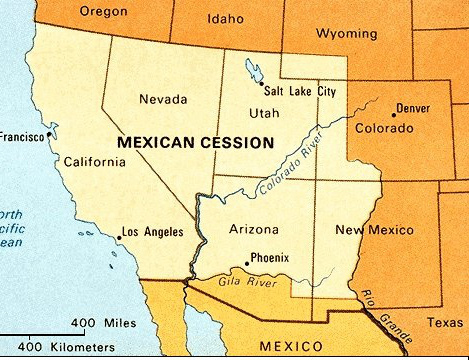
Negotiations with Mexico were difficult. But on Feb 2, 1848, agreement was reached and the Treaty of Guadalupe Hidalgo was signed, ending the war. The treaty gave the U.S. California, Nevada, Utah, and parts
of Colorado, Arizona, New Mexico, and Wyoming. In return, Mexico received $15 million and the U.S. assumed Mexican debts of $3.25 million owed to American citizens.
If Mexico had recognized Texas independence 10 years earlier, this war could have been avoided. While no American president would go to war over monetary claims against Mexico, once Mexico started the war, there had to be consequences. Compensation in the form of land became the policy. Polk said on Dec 7, 1847, “It is well-known that the only indemnity which it is in the power of Mexico to make in satisfaction of the just and long-deferred claims of our citizens against her and the only means by which she can reimburse the United States for the expenses of the war is a cession to the United States of a portion of her territory.”(12) The war cost at least $75 million.
x
The Peace Treaty of Guadalupe Hidalgo
After over a decade of insults and obstinate refusals to negotiate, Mexico had finally been put into a position where it had no choice but to finally make a deal. In a country with about 7 million people, a tiny American Army had taken control of the capital city, the main port of Veracruz, many major cities and ports, arsenals, forts and even the mines in Mexico plus all the territory north of the Rio Grande River – Upper California and New Mexico.. The state of Yucatan had refused to send any men to fight the Americans. Most of the native Americans living under Mexican rule felt no desire to defend Mexico. By the end of the war, Mexico only had 8,109 men left in their army(112) and the country was broke.(113) The US could continue to occupy these cities indefinitely because the vast majority of the Mexicans were content to live under US occupation. The average Mexican had it better living under the US military than under their own corrupt government. Some Mexicans wanted the US to annex ALL of Mexico so it would have good government.(114a)
This realization by the ruling class in Mexico meant that it was time to make a deal so the “hated” gringos would go home. On Oct 20, 1847, negotiations to end the war were started with Pena y Pena, the head of the interim government and a moderate who wanted peace. The negotiations continued slowly til the end of January, 1848, when the Mexican side accepted the new boundaries but demanded $30 million for the territory. The US negotiator, Nicholas Trist, turned this down, but on Feb 2, 1848, agreement was reached and the Treaty of Guadalupe Hidalgo was signed, ending the war.
The treaty gave the U.S. California, Nevada, Utah, and parts of Colorado, Arizona, New Mexico, and Wyoming. In return, Mexico received $15 million and the U.S. assumed Mexican debts of $3.25 million owed to American citizens. As Bernardo Couto, one of the negotiators put it, “The present treaty does not merely prevent an increase of our losses by a continuance of the war; but it serves to recover the better part of that which was already under the control of the conquering army of the United States; it is more exactly an agreement of recovery than an agreement of cession.” U.S. troops were withdrawn from Mexico by August 1848.
The reality is that the U.S. was far more generous to Mexico then they needed to be. We paid Mexico $15 million for New Mexico and California – land we already controlled – and the U.S. gave back to Mexico the land we had conquered south of the Rio Grande. Unlike so many other conquering armies, the U.S. treated civilians with respect, paid their just bills, took care of wounded Mexican soldiers and did not pillage the riches of Mexico – primarily Catholic Churches.
False Land Claims by Mexico
Mexico’s false land claims against the U.S. start with the Treaty of Tordesillas – signed in 1494!! This Treaty, brokered by Spanish born Pope Alexander VI, declared Spain had the right to claim all of the New World except for Brazil, which was colonized by Portugal. This treaty ignored all other countries and the rest of the world ignored this treaty. The mind set this 500 year old treaty produced is why many Mexicans believe they have the God ordained right to ignore the border between the U.S and Mexico and take political control of parts of the U.S. People in Mexico are put out that they lost their massive land holdings in N. America. But you can’t change facts.

Mexicans ignore all subsequent treaties. In 1803, the US bought a huge amount of land from France that became known as the Louisiana Purchase. This land had been under Spanish rule from 1763 until October 1, 1800, when Napoleon persuaded a reluctant King Charles IV of Spain to cede Louisiana back to France.
In 1819, Spain signed the Adams-Onis Treaty, which ceded Florida to the US and settled other boundary disputes.
In May 1836, Santa Anna provoked a rebellion in the state of Texas that resulted in the country of Texas. Mexico attacked the U.S.to start the Mexican American war in 1946. Mexico lost the war and the southwest U.S.
Mexico lost the war and the southwest U.S.
In June, 1854, the U.S. acquired the southern third of Arizona and parts of New Mexico, which became known as the Gadsden Purchase. Most Mexicans and many Americans believe that Mexican leader Santa Anna was bullied by the US into selling this land for building a railroad. This is NOT true. Santa Anna wanted to sell this land because he needed money. After Santa Anna received $10 million for this land. He stole $700,000 for his personal use and the rest was used to pay off adversaries and allies.(3)(4)(5)(126)
In July 1855, Santa Anna attempted to obtain additional funds from the US by selling more Mexican land but the US wasn’t interested.
For all of these reasons, the U.S. has legal ownership of all of the U.S. CASE CLOSED.
———————————-
Because of this fake info, activists preaching hate have sprung up since the 1950s starting political movements.
Augustin Cebada, Information Minister of the Brown Berets, para-military soldiers of Aztlan movement:
“. . . We’re here in Westwood, this is the fourth time we’ve been here in the last two months, to show white Anglo-Saxon Protestant L.A., the few of you who remain, that we are the majority, and we claim this land as ours, it’s always been ours, and we’re still here, and none of this talk about deporting. If anyone’s going to be deported it’s going to be you!”
“You old white people, it is your duty to die. Even their own ethicists say that they should die, that they have a duty to die. They’re taking up too much space, too much air. .
————————————
Reies Tijerina, a very influential Mexican-American racist from the 1950s, referenced the Treaty of Tordesillas to justify forcing all Anglos to move back to Europe!(130)
————————————-
Rodolfo “Corky” Gonzales, in his autobiography, Message to Aztlan declared: “We are all heirs to the land. We, the mestizo, the Indian, and of Spanish birth, owners of the Southwest by precedent and by legal title.”(132)
————————————
MALDEF (Mexican American Legal Defense Fund) is another hate group. (9) MALDEF was co-founded in 1968 by Mario Obledo and Pedro Tijerina. Obledo wants White People to go back to Europe.
Obledo: “We’re going to take over all the political institutions of California. In five years the Hispanics are going to be the majority population of this state.”
Caller: “You also made the statement that California is going to become a Hispanic state, and if anyone doesn’t like it, they should leave. Did you say that?”
Obledo: “I did. They ought to go back to Europe.” (10)(131)
Sources, Notes
1. http://www.tshaonline.org/handbook/online/articles/jcc02
2. http://www.tshaonline.org/handbook/online/articles/qyg01
3. War with Mexico, vol1. (1919), Justin H. Smith p. 57
Justin Smith was born in 1857 in New Hampshire; died 1930 in Brooklyn, New York. Educated at Dartmouth (B.A. 1877; M.A. 1881) and Union Theological Seminary (1879-1881). Smith worked for Charles Scribner’s Sons publishers 1881-1883 and Ginn & Co. 1883-1898 (becoming a partner in 1890); he was Professor of Modern History at Dartmouth 1899-1908. He resigned his professorship in 1908 to pursue historical research, and published The Annexation of Texas in 1911 and The War with Mexico in 1919.
For the latter he received the Pulitzer Prize in 1920 and the first Loubat Prize in 1923. From 1917 to 1923 Smith was chairman of the Historical Manuscripts Commission of the American Historical Association. Smith is regarded as the most thorough researcher of the war. Smith declared that nine tenths of the material he used in the preparation of this work was new information. His search extended to the archives of Great Britain, France, Spain, Cuba, Columbia, Peru, American and Mexican states and Mexican cities.
Smith examined over 100,000 manuscripts, 1200 books and pamphlets and 200 periodicals. Smith talked or corresponded with as many of the veterans as he could reach and spent more than a year in Mexico. All of the material used by Smith to write his book takes up 7 linear feet at the Benson Latin American Collection at the University of Texas at Austin. This information is from the Preface of the War with Mexico, vol 1. (1919), Justin H. Smith.
Leave a Reply